 Insights
Sub-synchronous oscillations are back, and the grid around them has changed
Part 1 of GridAxon's technical series on sub-synchronous oscillations
Original: gridaxon.io/insights/sso-why-oscillations-are-back.html
In short
Sub-synchronous oscillation (SSO) is an exchange of energy between the power system and a generator, a converter, or a load at a frequency below 60 Hz. When the system cannot damp that exchange, it grows. Turbine shafts crack, wind turbines trip, and in the worst historical cases the damage happens in less than a second.
For most of the industry, SSO has been a specialist's topic. It came up when someone proposed a series capacitor near a coal plant, a study was run, and everyone went back to load flow. That arrangement is ending. The generators have changed, the grid between them has changed, and now the loads are oscillating too.
The version of the problem most engineers learned
The classic case is Mohave, in Nevada. In December 1970, and again in October 1971, a turbine-generator shaft was damaged after the plant was left radial to series-compensated lines. The shaft had been twisting at one of its natural frequencies, fed by an electrical resonance in the network. The investigation that followed gave us most of the vocabulary we still use.
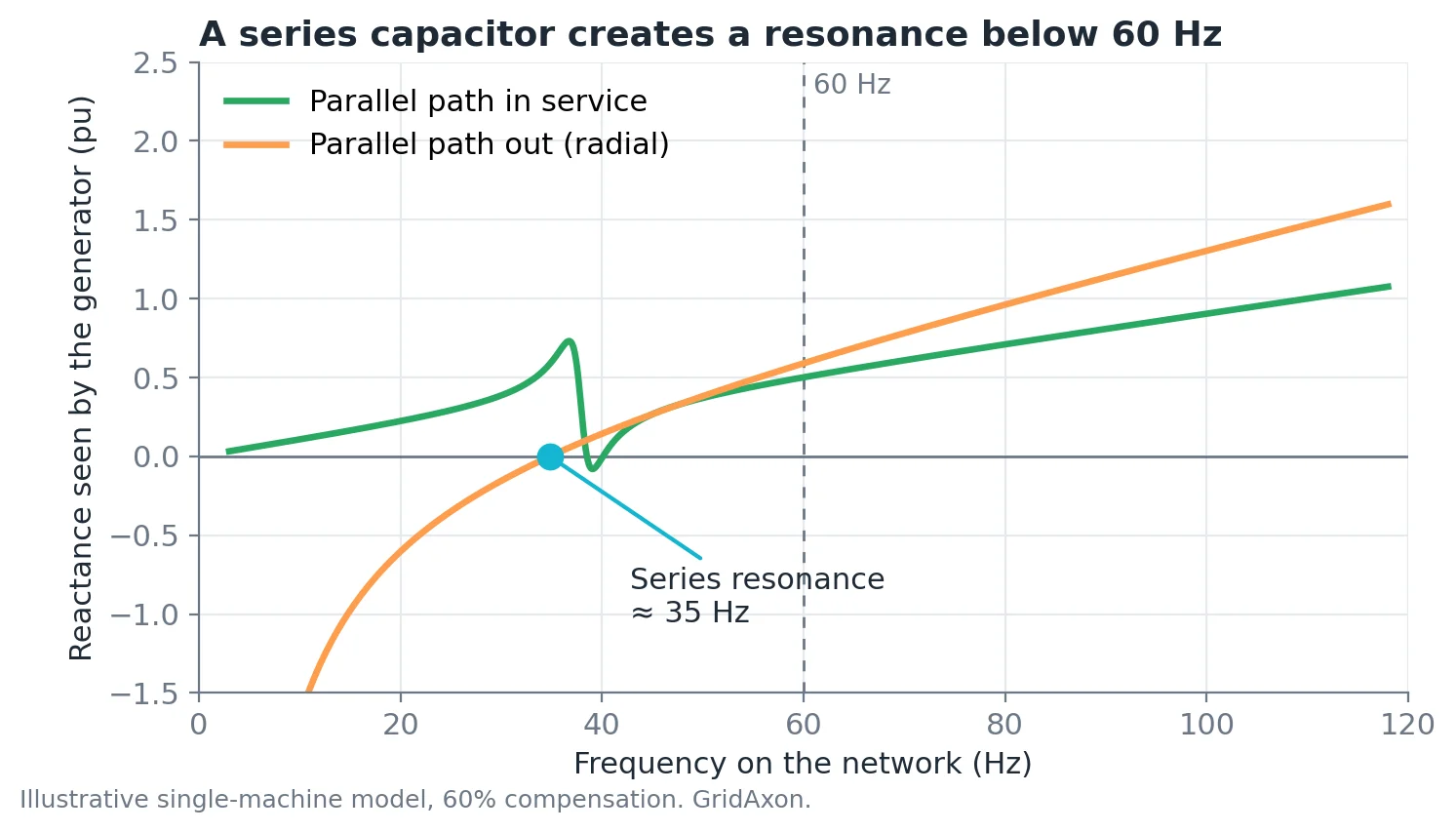
The lesson was clear and the fix was mostly procedural. Series capacitors are valuable because they cancel part of a long line's inductance and let more power move. They also create a resonance below 60 Hz. If a large spinning machine sits on the wrong side of that resonance, you study it carefully, you add protection, and you avoid the switching conditions that put it at risk.
The 2009 South Texas event was the warning shot
In October 2009, a fault in South Texas left two wind plants, 485 MW of capacity from roughly 300 Type 3 turbines, connected radially through a single 80-mile, 345 kV line with 50% series compensation. Within 200 milliseconds the oscillation had grown large enough to damage turbine equipment, with voltages above 1.5 per unit. Voltage kept climbing toward 2 per unit until the series capacitors were bypassed, about 1.5 seconds after the initiating trip. NERC later published it as a lesson learned.
There was no turbine shaft involved in the usual sense. The interaction ran through the machine and its power electronics. The converter, and in this case its protective crowbar, shaped how the machine looked to the network at sub-synchronous frequencies. The physics was old. The equipment was new, and the old screening assumptions did not cover it.
ERCOT has tightened its rules steadily since then. Its protocols require an SSR vulnerability assessment as part of generator interconnection. PGRR120, approved by the PUCT in November 2025 and effective December 1, 2025, goes further. A generator whose original interconnection agreement is executed on or after April 1, 2026 cannot connect where a single credible contingency would leave it radial to a series capacitor. Modifications to existing generators in that position must show by simulation that SSO is absent or fully mitigated before they are energized.
Three things are different now
The generators are mostly converters. Wind, solar, and storage connect through power electronics. Their behavior at 15 Hz or 35 Hz is set by control design and firmware, not by copper and steel. Two plants with the same nameplate can respond very differently. That response can also change with a firmware update nobody told the planner about.
The grid between them is getting thinner. Synchronous units that once provided strength and damping are retiring or running less. Long series-compensated corridors carry West Texas power east. A point of interconnection that looked well-meshed in one planning case can be one outage away from radial in another.
The loads have started to oscillate. This is the part that is new. On May 4, 2026, NERC issued a Level 3 Essential Action alert on computational loads, citing large customer-initiated load drops and significant oscillations that unfold in seconds, too fast for operators to respond in real time. NERC's March 2026 gap assessment identifies large loads, computational loads among them, as a potential source of significant forced oscillations in the 0.1 to 30 Hz range. The Project 2026-02 standards for computational loads, developed on an expedited timeline, passed final ballot in October 2026 and now go to the NERC Board and then to FERC. And PNNL's September 2026 case studies on WECC planning models found that even modest 50 MW forced oscillations at resonant frequencies can produce wide-area power swings, N-1 violations and cascading generator trips. That is a simulation result, not an observed event, but it shows how little forcing it takes when the frequency is wrong.
ERCOT is already treating load oscillation as a shaft problem
Most of the national large-load discussion is about inter-area modes below a few hertz. But the upper end of the 0.1 to 30 Hz range overlaps the first torsional modes of many large steam and combined-cycle turbine-generators. For reference, published analyses of the IEEE First Benchmark Model for SSR place its five shaft torsional modes at roughly 16 to 47.5 Hz.
The physics is simple. A load whose power pulses at some frequency produces an electrical torque at that same frequency in the rotor of a nearby generator. If that frequency sits near a lightly damped shaft mode, the shaft is being pushed at its natural frequency. The classic SSO literature listed pulsating loads as an aggravating factor for torque amplification decades ago.
ERCOT has seen something like it in its own data. On October 25, 2024, it recorded a roughly 50 MW peak-to-peak oscillation at about 23 Hz at a large load. ERCOT's own presentation is careful to treat the cause as an open question.
Since then ERCOT has screened its system for how exposed nearby generators are to this kind of load swing. Its September 2026 board materials said large-load power variations can perturb synchronous generator shafts and potentially cause fatigue or damage, and it is now proposing a limit on how much large computational loads may swing their demand. Part 3 of this series covers that rule in detail.
What stands out to us is that this is torsional interaction and torque amplification theory from the 1970s, applied to a new forcing source.
The part of the network that screening usually ignores
There is a second, quieter effect. Classic SSO screening treats paths that lead only to loads as negligible. A load branch is high impedance and carries little energy compared with the radial path from the generator to the series capacitor, so it gets dropped as an accounting simplification.
That assumption was made for ordinary load. It does not hold for a 500 MW or 1 GW data center on its own transmission connection. Loads do provide some damping. But once a load gets that large, the lines feeding it become parallel paths in their own right. They change where the resonance sits and what can safely be left out of the model. This came up in one of our internal training sessions, and we think it deserves more attention than it gets.
A large load can shift a resonance as surely as a new line can. It belongs in the screening model, represented properly, rather than left out by habit.
What has not changed
The physics is the same, and so is the method that works. You screen broadly, across outages, dispatch, and plant configurations, with frequency scans and simple interaction checks. Then you simulate narrowly in EMT on the handful of conditions that screening flags. Skip the screening and you either miss the one bad contingency or you run EMT on everything and never finish.
The study requirements have grown the same way. ERCOT's SSR study scope guideline asks for inverter-based plants to be studied across dispatch level, reactive power dispatch and the number of units online, including low-dispatch cases at leading and lagging power factor. Those scenarios reflect what earlier frequency scans showed the results to be sensitive to.
The practical lessons from fifty years of SSO work also still hold:
- Choose the point of interconnection carefully. Multiple lines at the POI reduce risk. Tapping a series-compensated line is usually a bad idea.
- Start the SSO study early. Late studies, a poor POI, or the wrong equipment can delay energization by months.
- Plan for the data problem. OEM models suitable for sub-synchronous studies are hard to get and often arrive late. Ask for them at the start.
What's next in this series
The terminology in this field is genuinely confusing. SSR, SSCI, SSTI, and IGE get used loosely, and that causes real scoping mistakes. Part 2 is a field guide to what each term actually means. Part 3 covers ERCOT's proposed limit on data center power variation. Later parts cover series capacitors, wind turbine count effects, torsional interaction, and why a frequency scan is a first pass rather than an answer.
GridAxon builds study automation for power system engineers, including our own tools for sub-synchronous screening across thousands of system conditions.
Sources
- ERCOT, Interconnection and Grid Analysis Update, Board of Directors, Sept 2026
- ERCOT, Large Load presentation at ORNL EMT Workshop (23 Hz oscillation event), 2025
- NERC Level 3 Essential Action Alert: Computational Loads (May 4, 2026)
- NERC, Assessment of Gaps in Existing Practices, Requirements, and Reliability Standards for Emerging Large Loads (March 2026)
- NERC Standards Project 2026-02 Computational Loads (passed final ballot, Oct 15, 2026)
- PNNL-39459, A Methodology to Evaluate the Grid Reliability Impact of Oscillations Induced by Large Loads (Sept 2026)
- ERCOT PGRR120, SSO Risk Reduction for Generator Interconnection
- ERCOT, Subsynchronous Resonance (SSR) Study Scope Guideline, v2.3, Oct 2020
- L.C. Gross, paper on the October 22, 2009 south Texas SSCI event, 2010 (hosted by ERCOT)
- NERC, "Lesson Learned: Sub-Synchronous Interaction between Series-Compensated Transmission Lines and Generation," Lesson Learned No. 20110705, July 26, 2011
- IEEE SSR Task Force, "First Benchmark Model for Computer Simulation of Subsynchronous Resonance," IEEE Trans. PAS-96, no. 5, pp. 1565–1572, Sept/Oct 1977
- D.N. Walker, C.E.J. Bowler, R.L. Jackson, D.A. Hodges, "Results of Subsynchronous Resonance Test at Mohave," IEEE Trans. PAS-94, no. 5, pp. 1878–1889, Sept 1975
Educational content, not engineering advice for a specific project.