 Insights
SSR, SSCI, SSTI, IGE: a field guide to the sub-synchronous alphabet
Part 2 of GridAxon's technical series on sub-synchronous oscillations
Original: gridaxon.io/insights/sso-terminology-field-guide.html
In short
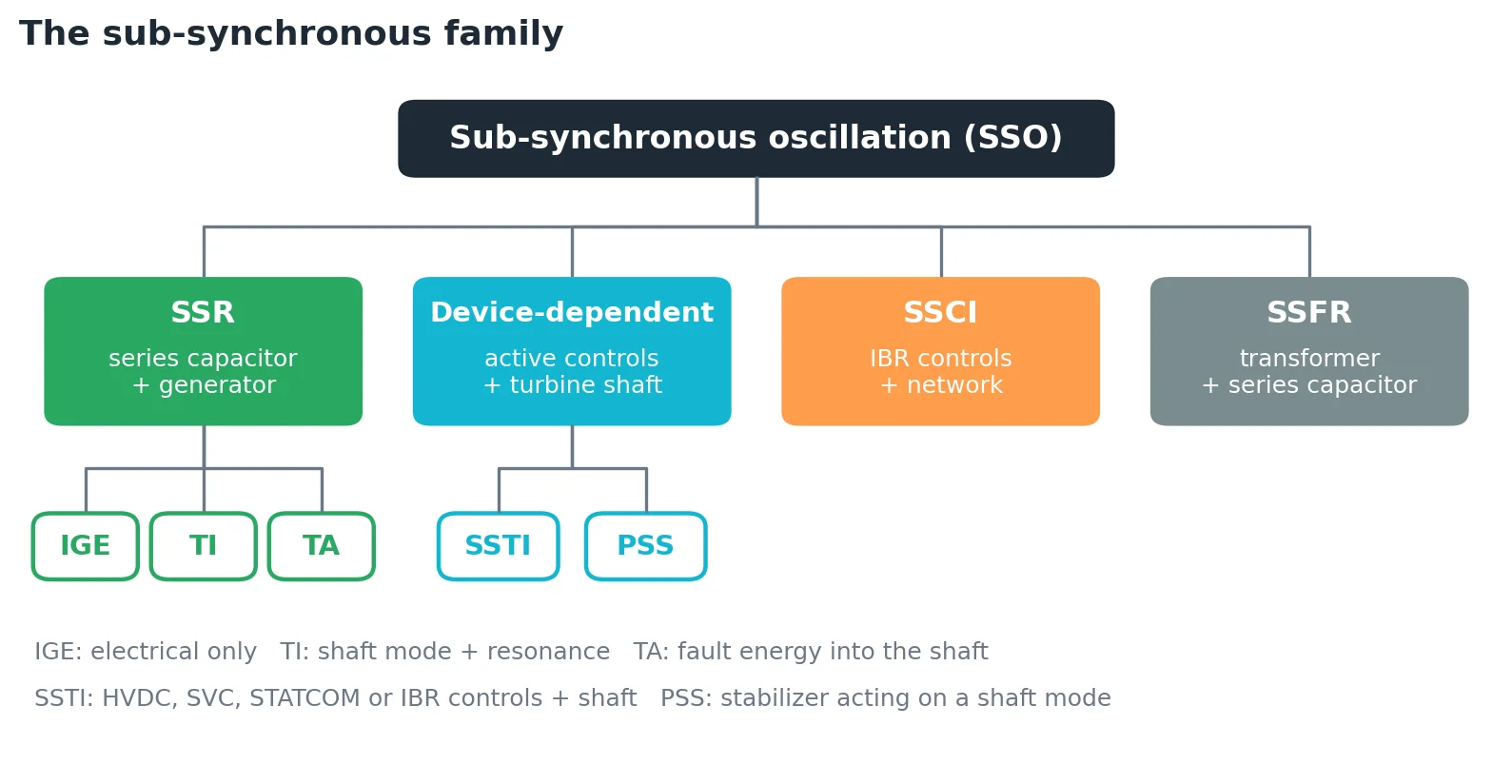
Sub-synchronous oscillation (SSO) is the umbrella term for any oscillatory exchange of energy between the grid and a machine, converter, or other device below the system's rated frequency. Everything else in this field (SSR, IGE, TI, TA, SSTI, SSCI) is a specific mechanism underneath that umbrella. The mechanisms differ in what is interacting, whether a series capacitor is required, and how you screen for them.
Getting the names right is not pedantry. A study scope that says "SSR study" can mean three different pieces of work, and the one that gets skipped is usually the one that matters.
Where the vocabulary came from
Most of the terms were standardized by the IEEE SSR Working Group in 1985, building on a set it first proposed in 1980, after a decade of investigation following Mohave and Square Butte. That paper is still the reference. The two later additions, SSCI and sub-synchronous ferroresonance, came from wind plant experience and from ERCOT's work on series-compensated corridors.
The terms, side by side
| Term | What interacts | Series capacitor needed? | Typical first screen | Classic example |
|---|---|---|---|---|
| SSR, Sub-synchronous resonance | A generator and a series-compensated network. Umbrella for IGE, TI and TA | Yes | Depends on the mechanism below | Mohave, 1970–71 |
| IGE, Induction generator effect | The electrical resonance and the machine's rotor circuit. Purely electrical, no shaft | Yes | Impedance scan; check the sign of total resistance at the resonance | Type 3 wind on a compensated line |
| TI, Torsional interaction | A turbine-generator shaft mode and the electrical resonance | Yes | Electrical damping from scans, compared with mechanical damping per mode | Mohave investigations |
| TA, Torque amplification | Energy stored in the series capacitor during a fault, released into a shaft mode after clearing | Yes | Scans to pick cases, then EMT fault simulations | Mohave investigations |
| SSTI, Sub-synchronous torsional interaction | A shaft mode and the controls of an active device: HVDC, SVC, STATCOM, IBR | No | Unit Interaction Factor; 0.1 is the usual threshold for conventional HVDC | Square Butte HVDC, 1977 |
| SSCI, Sub-synchronous control interaction | IBR controls and the network. ERCOT ties it to series compensation; wider usage includes weak-grid interactions | Per ERCOT, yes | Terminal transfer-function scans plus system scans, then EMT | South Texas wind, 2009 |
| SSFR, Sub-synchronous ferroresonance | A saturating transformer and a series capacitor | Yes | EMT with full saturation curves | Flagged by ERCOT as a distinct SSO type |
One related case sits outside the table: power system stabilizer interaction. A PSS tuned well for network swings below about 3 Hz can respond with the wrong phase to a disturbance that starts on the shaft. That is also device-dependent SSO.
Two of those screens deserve a caution. The Unit Interaction Factor came out of the research that followed Square Butte, where a turbine-generator sat electrically close to the HVDC rectifier, and its usual 0.1 threshold is an empirical value for conventional line-commutated HVDC. Most systems studied today look nothing like that. Our view is that it is often applied well outside the conditions it was built for, even though it usually lands close. Treat UIF as a coarse filter, and confirm anything near the threshold with damping calculations. The idea is also getting a second life: ERCOT's proposed limits for data center power variation compute an interaction-factor-based limit for each load location, so the most exposed nearby generator sets the cap.
Ferroresonance is the other. Frequency scans assume the network is linear, and a saturating transformer is not. On this we are deliberately old school: if you're looking for ferroresonance, do it in EMT, with saturation curves that run all the way out to the air-core region.
The concept that ties them together: two frames of reference
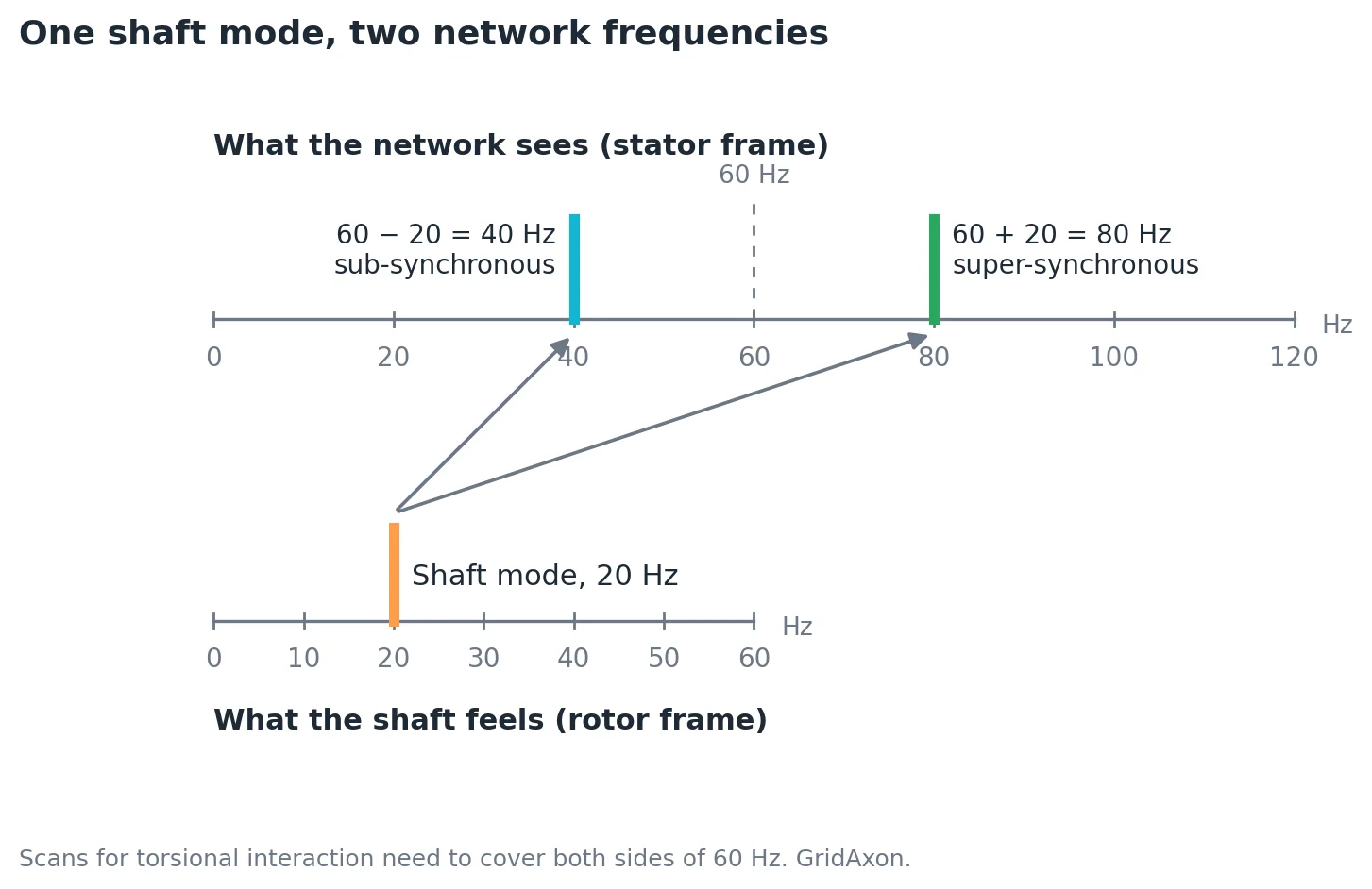
Shaft modes live in the rotor's frame of reference. The network sees the stator frame. A shaft oscillating at a mode frequency fm modulates the generator's output and produces currents at two frequencies on the network: 60 − fm and 60 + fm.
So a 20 Hz torsional mode shows up on the grid at 40 Hz and 80 Hz. This is why torsional interaction scans have to run from 0 to 120 Hz, not just up to 60. A scan that stops at 60 Hz throws away the super-synchronous half of the damping picture.
Even the sign of damping is not universal. Write the shaft torque equation one way and positive electrical damping means the network is undamping the shaft. Write it the other way and negative means undamping. We prefer the second: positive damping should mean the system is damping better. Check which convention a report uses before you compare its numbers with yours.
Our view on "SSCI"
The name SSCI was coined after the 2009 Texas event, because the problem could be fixed by changing converter controls. That made it sound like a controls problem. Even the last letter is unsettled: early papers on the event, and some ERCOT study material, spell it sub-synchronous control instability, while ERCOT's protocols and most of the industry now say interaction. We think the label hides something useful. In a Type 3 turbine, the converter sets the effective rotor resistance the network sees, and the instability looks a great deal like classic induction generator effect. The controls made it worse or better. The machine was still part of the mechanism.
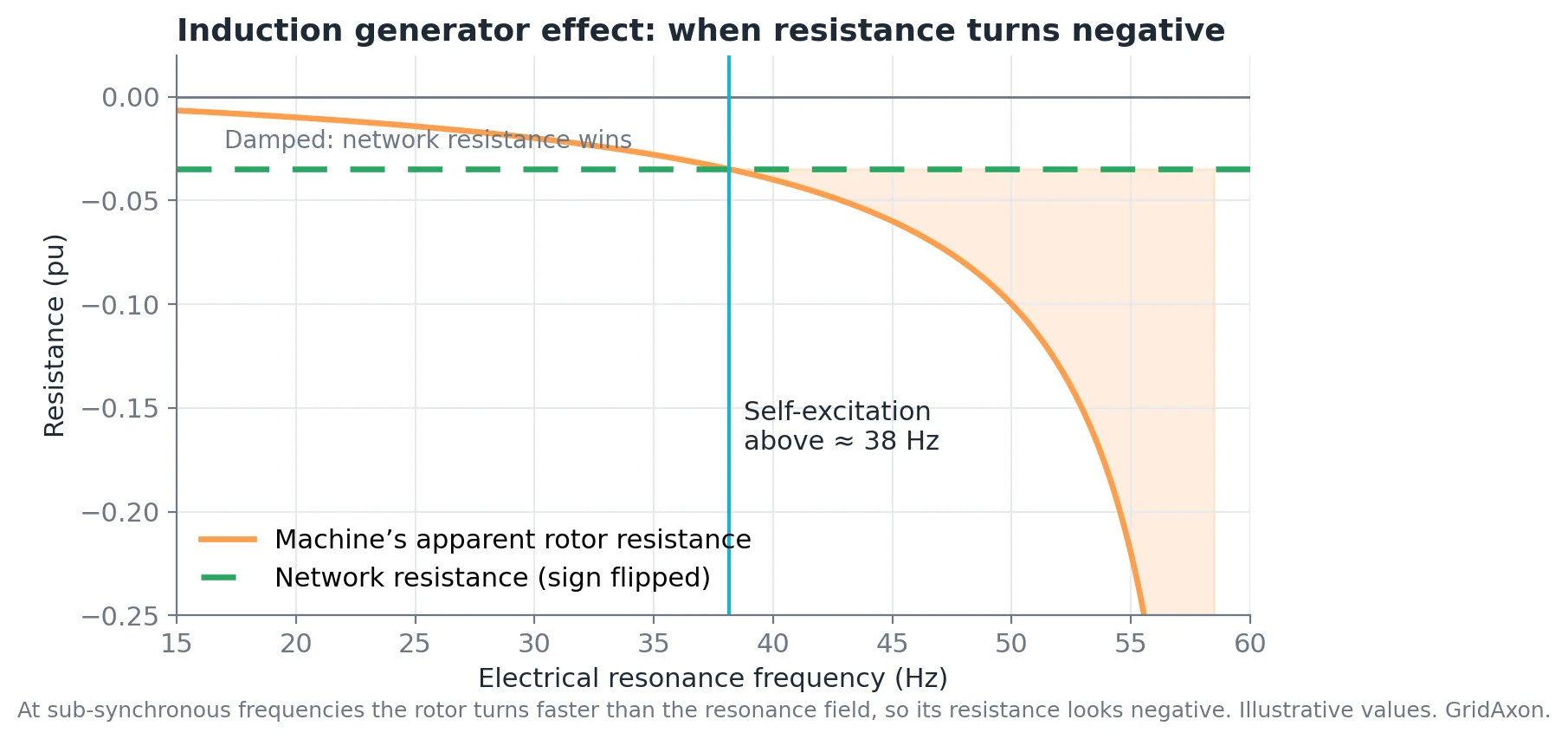
That distinction matters in practice. A Type 4 full-converter turbine isolates the machine from the grid, so induction generator effect is not expected. Its controls can still interact with a network resonance or with other devices. Same acronym, different physics, different study.
Definitions depend on who wrote them
ERCOT's protocols define SSCI specifically as an interaction between a series-compensated system and the control systems of generators, and, since its large-load revisions, of loads as well. Much of the wider industry uses the term, or "IBR oscillations," for control interactions in weak grids with no series capacitor anywhere nearby. ERCOT has also argued for SSO as the overarching term precisely because it covers ferroresonance, which SSR does not.
None of these usages is wrong. They come from different rulebooks, and the rulebooks are still moving: IEC has published a technical report that revisits the whole classification for converter-heavy grids. A study done to satisfy one rulebook may not answer the question another one asks.
Four questions to ask when someone hands you an "SSR study" scope
- Which mechanisms? IGE, TI, TA, SSTI, SSCI and ferroresonance need different methods. Name the ones in scope.
- Which machines? Synchronous units need shaft data: inertias, stiffnesses, modal damping. IBRs need EMT models valid at sub-synchronous frequencies. Each is a separate data request.
- Which method for each? Frequency scans for screening, UIF for SSTI, EMT for confirmation. A scan alone is not a final answer for torque amplification.
- How deep in outages? Most SSO risk appears only after a specific combination of line outages. The contingency depth is set by the system operator or transmission owner. Confirm it in writing before the work starts.
Next in this series
Part 3 looks at ERCOT's proposed 10 MW / 5-second limit on data center power variation, and what it means for developers.
GridAxon builds study automation for power system engineers, including our own tools for sub-synchronous screening across thousands of system conditions.
Sources
- IEEE SSR Working Group, "Proposed Terms and Definitions for Subsynchronous Oscillations," IEEE Trans. PAS-99, no. 2, pp. 506–511, March 1980
- IEEE SSR Working Group, "Terms, Definitions and Symbols for Subsynchronous Oscillations," IEEE Trans. PAS-104, no. 6, pp. 1326–1334, June 1985
- M. Bahrman, E.V. Larsen, R.J. Piwko, H.S. Patel, "Experience with HVDC–Turbine-Generator Torsional Interaction at Square Butte," IEEE Trans. PAS-99, no. 3, pp. 966–975, May/June 1980
- L.A. Kilgore, D.G. Ramey, M.C. Hall, "Simplified Transmission and Generation System Analysis Procedures for Subsynchronous Resonance Problems," IEEE Trans. PAS-96, 1977
- L.C. Gross, paper on the October 2009 south Texas SSCI event, 2010 (hosted by ERCOT)
- ERCOT, PGRR120 presentation to ROS with SSO, SSR, SSCI and SSFR definitions (Nov 2024)
- ERCOT comments on PGRR120 on using SSO as the umbrella term (Apr 2025)
- ERCOT comments on NPRR1234 with revised SSO definitions covering Loads (Nov 2024)
- IEC TR 63401-2, terms and classification of subsynchronous oscillations (preview)
- P.M. Anderson and R.G. Farmer, Series Compensation of Power Systems, 1996
Educational content, not engineering advice for a specific project.