 Insights
ERCOT's 10 MW / 5-second rule: what data center developers should know
Part 3 of GridAxon's technical series on sub-synchronous oscillations
Original: gridaxon.io/insights/sso-ercot-10-mw-5-second-rule.html
In short
ERCOT's proposed power variation limit caps how much a large computational load, such as an AI data center, may swing its demand. The draft language allows no more than 10 MW peak-to-peak of active power variation in any rolling 5-second window, measured across 0.1 to 55 Hz. The purpose is to protect the shafts of nearby synchronous generators from fatigue and damage.
If you are siting a data center in Texas, this is a design constraint, not a compliance footnote. Here is what the rule says, why ERCOT landed on it, and what it means for a project.
What the rule says
The limit targets repetitive, persistent power cycling. ERCOT has said that infrequent power steps above 10 MW would not violate it, and that checking compliance will need high-resolution measurement such as PMU data. In its September 2026 board materials, ERCOT described this as a draft Large Load MW Variation Requirements NOGRR that it plans to propose. As of early November 2026 we could not find a numbered filing, so treat the details, including whether the limit will apply to existing loads, as subject to change.
Why ERCOT landed on 10 MW
The reasoning runs from the generator shaft outward, and it is worth following because it explains how tight the number is.
ERCOT starts with how much cyclic torque a generator shaft can tolerate indefinitely, and how much a power swing at the terminals gets amplified into shaft torque. Dividing one by the other gives a maximum continuous power variation at the generator terminals. In ERCOT's own example, a 100 MW generator can tolerate about 1 MW of continuous oscillating power.
Next comes the question of how much of a load's swing reaches each nearby generator. ERCOT calculates an interaction-factor-based limit for each load location, and the most exposed generator sets it. Screening every bus at 100 kV and above showed the number of affected generator stations rising quickly as the injected variation grew.
ERCOT could have required a site-specific study for every load. It chose a single limit instead, and gave two reasons. A simple criterion lets future loads skip time-consuming generator interaction studies. And the generator data those studies need can be very difficult to obtain.
Why 10 MW is a small number
For a 300 MW campus, 10 MW is about 3% of the load. AI training workloads can move power in large, synchronized steps as thousands of processors start and stop together. Without some form of buffering or control, that kind of profile can exceed the limit by a wide margin.
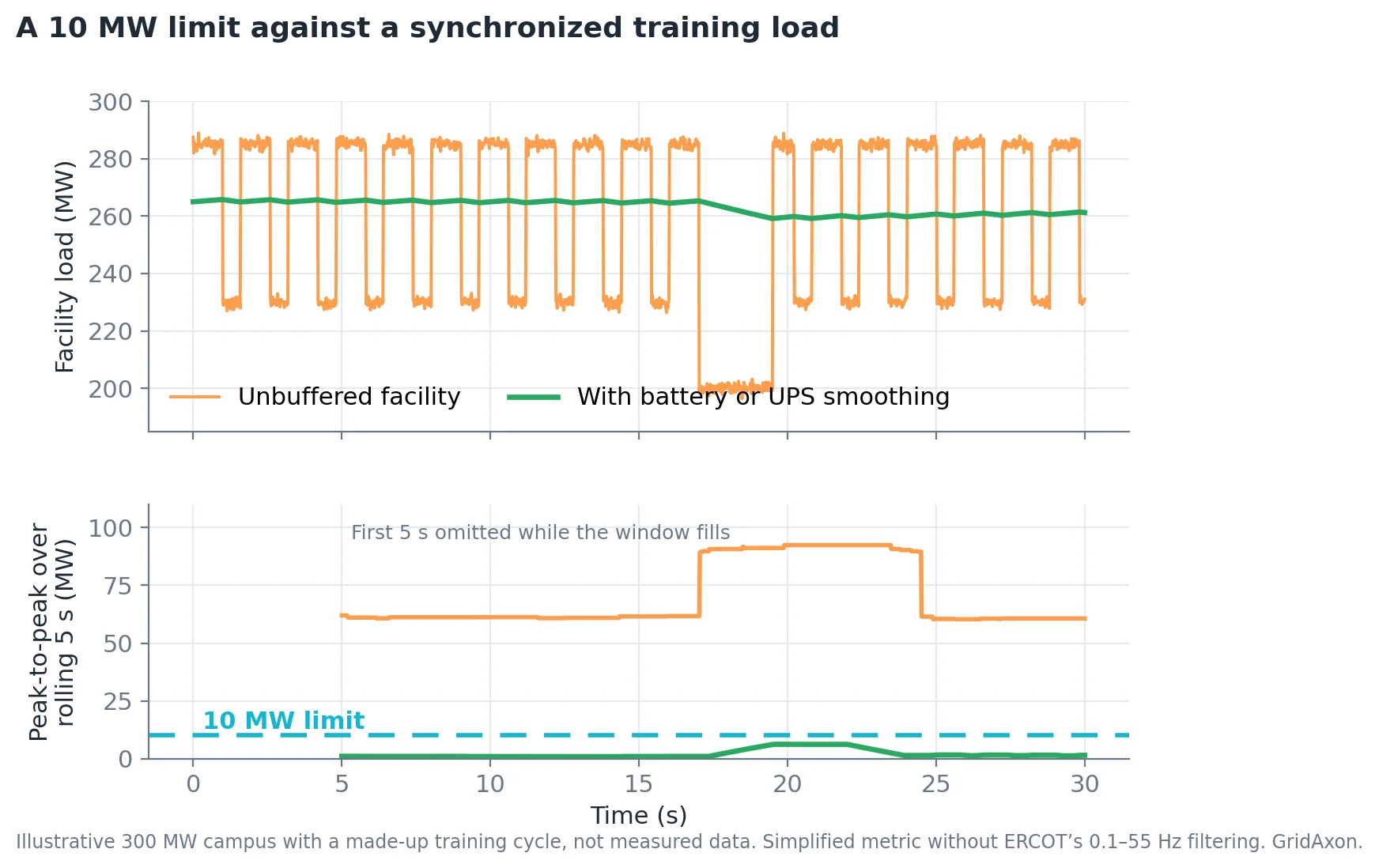
The frequency window matters too. Sub-synchronous content from 0.1 to 55 Hz covers inter-area modes at the bottom and turbine-generator torsional modes higher up. ERCOT itself lists the potential to excite synchronous generator torsional modes among the defining traits of these loads. The classic SSO literature has long treated shaft fatigue as cumulative: each oscillation cycle above the endurance limit uses up a little shaft life, and nothing gives it back. A load that cycles continuously is the worst case for that kind of damage, which is why the rule is written around repetition and not single events.
What we'd tell a developer
- Treat power variation as a facility design requirement. Battery or UPS buffering, workload scheduling and power capping are the levers. Decide early which of them the design will rely on, because retrofitting is expensive.
- Plan to measure. If compliance is judged on high-resolution data, you need PMU-grade measurement at the point of interconnection and a commissioning test that shows the facility's real profile.
- Know your neighbors. The limit exists because of nearby synchronous machines. Proximity to large thermal units and to series-compensated lines tells you how much margin the location really has, even if the rule itself is uniform.
- Don't forget the series capacitors. ERCOT already asks loads near series capacitors to complete an SSO survey covering load composition and UPS arrangement. The power variation limit is in addition to that, not instead of it.
The question nobody has fully answered: on-site generation
Many large-load proposals now include generation on site, often gas turbines. That puts a synchronous shaft electrically closer to the load than anything on the grid. If the shaft protection logic is "limit what reaches the nearest generator," the nearest generator may now be inside the fence. We expect co-located generation to need its own torsional review regardless of how the grid-level rule ends up.
Next in this series
Part 4 goes back to the events that defined the field, Mohave, Square Butte and South Texas, and what each one changed about how studies are done.
GridAxon builds study automation for power system engineers, including our own tools for sub-synchronous screening across thousands of system conditions.
Sources
- ERCOT, Interconnection and Grid Analysis Update, Board of Directors, Sept 2026
- ERCOT, LCL Power Variation Limit Discussion, LLWG, June 2026
- ERCOT, LCL Power Variation Limit and Monitoring Requirement, LLWG, Apr 2026
- ERCOT, Large Load Power Variation Requirement Consideration, LLWG, Feb 2026
- ERCOT, Large Load Subsynchronous Survey
Educational content, not engineering advice for a specific project.